Table of Contents
ToggleAn honorary doctorate sounds impressive—and it is. But what can you actually do with it in real life?
There’s a lot of confusion (and misinformation) around this topic. Some people think it gives you the same power as a traditional PhD.
It doesn’t.
Let’s separate reality from myth so you know exactly what an honorary doctorate means for you.
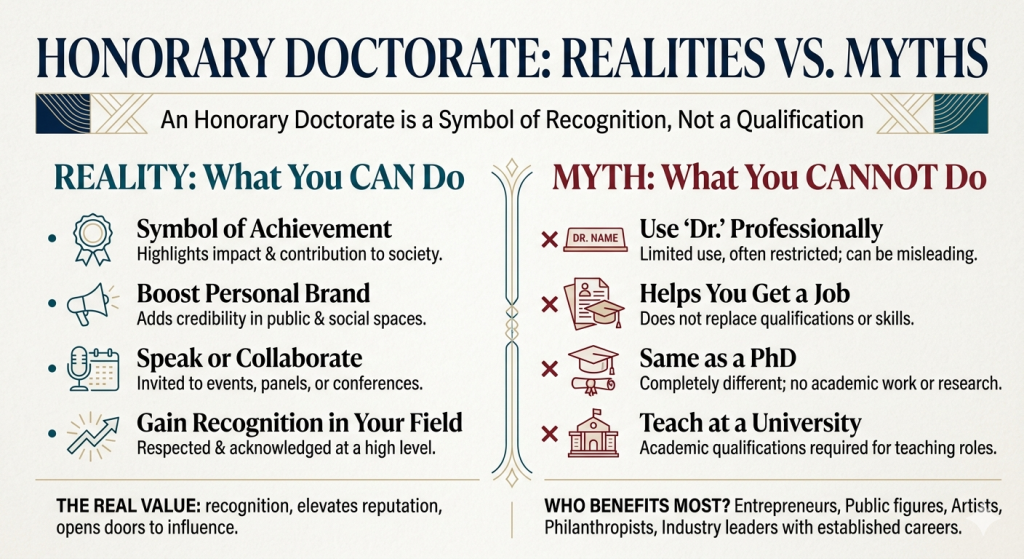
What Can You Do with an Honorary Doctorate?
An honorary doctorate is a recognition, not a qualificationand honorary degree criteria.
Here’s what you can actually do with it:
Use it as a symbol of achievement
It highlights your impact, success, or contribution to society
Boost your personal brand
It adds credibility and authority to your name, especially in public or social spaces
Be invited to speak or collaborate
Many honorary degree holders are invited to events, conferences, and panels
Gain recognition in your field
It positions you as someone respected and acknowledged at a high level
That’s the real value—recognition, not certification and college accreditation.
Myth vs. Reality
Myth: You can use “Dr.” professionally
Reality: Limited and often restricted
Yes, some people use “Dr.” socially after receiving an honorary doctorate.
But professionally, it’s a different story.
Most institutions and industries do not recognize honorary doctorates as valid academic qualifications.
Using “Dr.” in professional or medical contexts can be misleading—and sometimes even unethical.
In many cases, universities themselves advise recipients not to use the title formally.
Myth: It helps you get a job
Reality: No, it doesn’t replace real qualifications
You cannot use an honorary doctorate to apply for jobs that require an actual degree.
Employers look for:
Academic credentials
Skills and experience
Certifications
An honorary degree does not meet these requirements.
It may enhance your profile—but it won’t qualify you for roles.
Myth: It’s the same as a PhD
Reality: Completely different
A PhD is earned through years of study, research, and a dissertation.
An honorary doctorate is awarded without academic work.
Both are respected—but for different reasons.
Confusing the two can damage credibility rather than build it.
Myth: You can teach at a university
Reality: Not based on this degree alone
Universities require academic qualifications for teaching roles.
An honorary doctorate alone is not enough.
However, if you already have expertise or experience, it might help you get invited as a guest speaker—not a full-time academic.
So, What’s the Real Value?
If it doesn’t give you jobs or qualifications, what’s the point?
The value is in recognition.
An honorary doctorate validates your impact, elevates your reputation, and opens doors to influence—not employment.
Who Benefits the Most from It?
People who already have established careers or influence benefit the most from it.
Entrepreneurs
Public figures
Artists and creators
Philanthropists
Industry leaders
They use it to strengthen credibility—not create it from scratch.
Final Thoughts
An honorary doctorate is powerful—but only if you understand what it actually represents.
It won’t replace a degree.
It won’t get you a job.
It won’t make you academically qualified.
But it will recognize your journey, your work, and your impact.
And sometimes, that kind of validation carries more weight than any title.
Honorary Degree, Honorary Doctorate, Honorary Doctorate Benefits, Honorary Doctorate Facts, Honorary Doctorate Myths, Honorary PhD