
The distinction between accredited and unaccredited honorary degrees has become one of the most critical issues in higher education in 2026. With the rise of diploma mills, fake universities, and the increasing regulation of academic titles worldwide, understanding what makes an honorary degree legitimate—and what does not—is essential for recipients, employers, and the public. This comprehensive guide explores the complete landscape of accredited versus unaccredited honorary degrees, drawing on the latest regulations, institutional policies, and enforcement actions from 2026.
Table of Contents
Toggle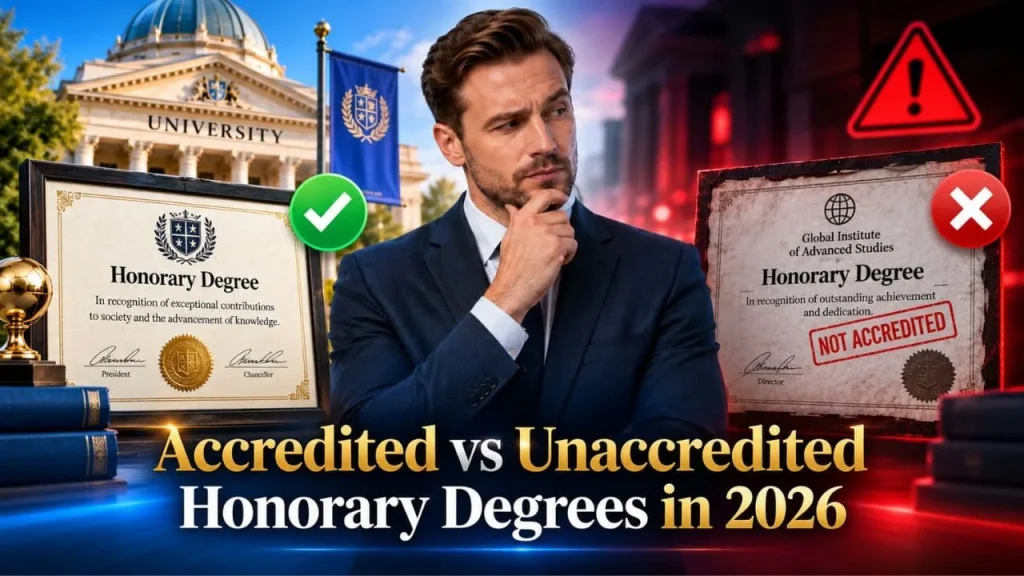
Table of Contents
- Introduction: The Growing Importance of Accreditation
- What Constitutes an Accredited Honorary Degree?
- The World of Unaccredited Honorary Degrees
- 2026 Regulatory Landscape
- How to Verify an Honorary Degree’s Legitimacy
- Consequences of Holding an Unaccredited Degree
- Frequently Asked Questions
- Final Thoughts
Introduction: The Growing Importance of Accreditation
In 2026, the distinction between accredited and unaccredited honorary degrees has never been more important. Regulatory bodies worldwide are cracking down on the misuse of academic titles, and the public is becoming increasingly aware of the difference between legitimate honorary degrees and those obtained from diploma mills.
An accredited honorary degree is one conferred by a recognized, legitimate institution that has met established standards of quality. Unaccredited honorary degrees, by contrast, are often awarded by institutions that lack proper authorization or academic standing, frequently in exchange for payment or political favor.
In 2026, the National Universities Commission (NUC) in Nigeria uncovered 32 institutions involved in the illegal and unethical award of honorary doctorate degrees, including 10 foreign universities, four unlicensed local universities, 15 professional bodies without degree-awarding powers, and three other institutions not authorized to confer academic titles [citation:8]. This investigation highlights the global scale of the problem.
2026 Insight: The global crackdown on unaccredited honorary degrees has intensified significantly. Regulatory bodies in Nigeria, Uganda, Ghana, and other countries have implemented strict guidelines to distinguish between legitimate academic credentials and honorary awards that are being misused for professional and social gain.
What Constitutes an Accredited Honorary Degree?
Definition of an Accredited Honorary Degree
An accredited honorary degree is one conferred by a recognized and legitimate institution that has met established standards of academic quality. In the context of honorary degrees, accreditation typically refers to the institution itself being properly recognized by the relevant national or regional authorities.
In the United States, institutions that award honorary degrees must be accredited by an agency recognized by the United States Department of Education or the Council for Higher Education Accreditation (CHEA). In Nigeria, only mature universities that meet defined operational criteria are allowed to award honorary degrees [citation:2]. In Uganda, only public universities, public degree-awarding institutions, private chartered universities, and accredited private institutions are authorized to confer honorary doctorates [citation:3].
Examples of Accredited Institutions
Some of the world’s most prestigious universities award accredited honorary degrees. Oxford University, for example, announced its 2026 honorary degree recipients, including Dame Jacinda Ardern, Professor Daron Acemoğlu, and Billie Jean King [citation:9]. These degrees are recognized as legitimate academic honors because Oxford is an accredited and globally respected institution.
Similarly, Wits University in South Africa has a long history of awarding honorary degrees to distinguished individuals, with records dating back to the 1960s and 1970s [citation:1]. These degrees carry academic weight because they are conferred by a recognized university with established standards.
Key Characteristics of Accredited Honorary Degrees
- Institutional Recognition: The awarding institution is properly accredited by recognized authorities.
- Clear Distinction: The degree is clearly designated as honorary, not earned.
- Transparent Process: Selection follows established procedures with oversight from academic and governing bodies.
- No Misrepresentation: Recipients are properly informed that the degree is honorary and not an earned credential.
- Limited Number: Reputable institutions typically award a limited number of honorary degrees each year.
Oxford University Honorary Degree Recipients 2026
- Dame Jacinda Ardern: Former Prime Minister of New Zealand, recognized for services to the State and leadership [citation:9]
- Professor Daron Acemoğlu: MIT economist and 2024 Nobel laureate [citation:9]
- Billie Jean King: Tennis legend and advocate for equality [citation:9]
- Professor Henry Louis Gates Jr.: Harvard scholar and Emmy Award-winning filmmaker [citation:9]
- Professor Katalin Karikó: Nobel laureate for mRNA vaccine research [citation:9]
These degrees are widely recognized as legitimate because Oxford University is an accredited institution with a rigorous selection process.
The World of Unaccredited Honorary Degrees
Definition of Unaccredited Honorary Degrees
Unaccredited honorary degrees are those awarded by institutions that lack proper recognition, authorization, or academic standing. These degrees are frequently associated with diploma mills, fake universities, and organizations that sell credentials without any academic requirements.
In 2025, the NUC investigation uncovered 32 institutions involved in the illegal and unethical award of honorary doctorate degrees in Nigeria [citation:8]. These included foreign universities, unlicensed local universities, and professional bodies without degree-awarding powers. The investigation revealed that these institutions were selling fake professorships and issuing unaccredited foreign awards [citation:2].
Common Types of Unaccredited Institutions
- Diploma Mills: Organizations that sell degrees for a fee without requiring any academic work.
- Fake Universities: Institutions that operate without proper authorization or accreditation.
- Unaccredited Foreign Institutions: Universities from other countries that lack proper recognition.
- Professional Bodies: Organizations that confer academic titles without degree-awarding authority.
- Religious Institutions: Organizations that use legal loopholes to grant degrees without academic requirements.
How Unaccredited Degrees Are Marketed
Unaccredited honorary degrees are often marketed to individuals seeking prestige or professional advancement. In Nigeria, prominent figures have received honorary doctorates from unaccredited universities in the United States, Benin, and Togo [citation:10]. In some cases, these degrees are awarded in exchange for financial contributions or political patronage [citation:12].
One frequently cited example is Prowess University, Delaware, which is not accredited by any agency recognized by the United States Department of Education, though it advertises accreditation-style endorsements from bodies outside that recognized system. Dozens of Nigerians have received honorary doctorates from the institution across a series of ceremonies held in recent years [citation:12].
Examples of Unaccredited Institutions Exposed in 2025-2026
- Prowess University Delaware: Not accredited by a US Department of Education-recognized agency; has conferred honorary doctorates on dozens of Nigerians across multiple ceremonies [citation:12]
- Escae Benin University: Granted honorary degrees to celebrities including Peter Okoye of P-Square [citation:12]
- ISMT St Salomon University: Awarded honorary doctorates in arts, leadership, and development [citation:12]
- ESTAM University: Granted degrees to Nigerian filmmakers and public figures [citation:12]
The NUC investigation identified a total of 32 institutions involved in the illegal award of honorary doctorate degrees [citation:8].
2026 Regulatory Landscape
Nigerian Regulations
In February 2026, the National Universities Commission (NUC) issued a sweeping set of guidelines aimed at regulating the “indiscriminate conferment and misuse” of honorary doctorates [citation:2]. The guidelines explicitly define honorary doctorates as symbolic recognitions and not earned academic qualifications. Recipients are barred from appending “Dr” to their names or presenting the awards as equivalent to a PhD [citation:2].
The guidelines also introduced strict eligibility thresholds for institutions seeking to confer honorary degrees. Only mature universities that meet defined operational criteria will be allowed to award them, making the distinction between accredited vs unaccredited honorary degrees increasingly important. The number of honorary degrees that can be conferred is also capped [citation:2]. Universities are required to secure approvals from their senate and governing council, publicly disclose recipients, and establish formal revocation procedures [citation:2].
In May 2026, the Federal Government finalized an official ban on honorary degree holders prefixing “Dr” to their names [citation:10]. However, a significant loophole remains: the NUC’s jurisdiction covers Nigerian universities, but it has no authority over foreign-conferred awards. Individuals who receive honorary degrees from unaccredited foreign institutions may continue using the “Dr” prefix without violating the new policy [citation:10].
Ugandan Regulations
Uganda’s National Council for Higher Education (NCHE) issued a firm public warning against the growing misuse of honorary doctorate titles in 2025 [citation:3]. The NCHE emphasized that honorary degrees—known as honoris causa—are purely ceremonial and should not be equated with earned academic qualifications. Recipients of honorary degrees must explicitly indicate the honorary nature of the award by including the designation “(Hon. Causa)” in any written or spoken reference [citation:3].
Under no circumstances should recipients of honorary degrees be addressed as “Doctor” or use the suffix “PhD” [citation:3]. The Council also stipulated that honorary degrees should only be awarded to individuals with prior academic qualifications and a proven record of national service or leadership [citation:3].
Zambian Regulations
The Zambia Qualifications Authority (ZAQA) has stated that honorary degrees do not qualify to be registered and accredited on the Zambia Qualifications Framework [citation:11]. While honorary degrees may be conferred by competent awarding bodies, they shall not be recognized by ZAQA. Recipients are advised to use “h.c.” or “Honorary Degree” to avoid misleading the public and to preserve the integrity of earned degrees [citation:11].
International Trends
In the United Kingdom, it is considered improper practice for an honorary doctor to use the prefix “Dr” in professional life. While recipients may use post-nominal letters (e.g., John Smith, Hon. D.Litt), the title is strictly ceremonial [citation:6]. The UK’s Committee of Vice-Chancellors and Principals has long held that honorary graduates should not use the title “Dr” in a way that implies they hold a higher degree [citation:6].
In the United States, recipients of honorary degrees do not use the “Dr” prefix. The honour is denoted in writing with “Hon.” or “HC” after the degree name. The American Medical Association and various state laws strictly regulate who can claim to be a medical doctor [citation:6].
Germany has some of the world’s strictest laws regarding academic titles. Using an unauthorized “Dr” title, including one from a non-accredited foreign university or an honorary one without the “h.c.” suffix, is a criminal offence punishable by fines or imprisonment [citation:6].
2026 Regulatory Summary: The global trend is clear: honorary degrees are being strictly regulated to distinguish them from earned academic credentials. Institutions that confer honorary degrees must be properly accredited, and recipients are prohibited from using the “Dr” title in professional contexts. Countries including Nigeria, Uganda, Ghana, and Zambia have implemented specific guidelines, while the UK, US, and Germany have long-standing conventions or laws in place.
How to Verify an Honorary Degree's Legitimacy
Check the Institution's Accreditation Status
The first and most important step is to verify that the institution is properly accredited. To verify a university’s accreditation status, check with the US Department of Education or the Council for Higher Education Accreditation (CHEA) in the United States. In Nigeria, confirm that the university is listed with the National Universities Commission. In Uganda, verify with the National Council for Higher Education.
Review the Selection Process
Legitimate institutions have transparent, documented procedures for selecting honorary degree recipients. The process typically involves a committee, approval from governing bodies, and clear criteria. If an institution cannot provide documentation of its selection process, it may not be legitimate.
Examine the Awarding Institution's Reputation
Prestigious, well-known universities are more likely to award legitimate honorary degrees. If an institution has a website full of grammatical errors, unclear contact information, or no verifiable address, it may be a diploma mill.
Check for Proper Designation
Legitimate honorary degrees are clearly designated as honorary on the certificate and in all official communications. The degree should include wording such as “honoris causa,” “Honorary,” or “h.c.” If a degree is presented as a PhD or other earned doctorate without any indication that it is honorary, it is likely not legitimate.
Verify the Recipient's Qualifications
Legitimate honorary degrees are typically awarded to individuals with significant achievements in their field. If an institution appears to award honorary degrees to anyone who pays a fee, it is almost certainly unaccredited.
Red Flags for Unaccredited Honorary Degrees
- No Accreditation: The institution is not recognized by any legitimate accrediting body.
- Payment Required: The degree is offered in exchange for a fee without any academic requirements.
- Vague Criteria: The selection criteria are unclear or non-existent.
- No Verification: The institution cannot provide documentation of its accreditation.
- Celebrity Focus: The institution primarily awards degrees to celebrities and public figures.
- Foreign Claims: The institution claims foreign accreditation that cannot be verified.
Consequences of Holding an Unaccredited Degree
Legal Consequences
In many countries, using an unaccredited honorary degree as if it were an earned credential can have legal consequences. In Nigeria, misrepresenting an honorary degree as an earned one is now treated as academic fraud, with possible legal consequences [citation:2]. In Germany, using an unauthorized “Dr” title is a criminal offence punishable by fines or imprisonment [citation:6].
Professional Consequences
Holding an unaccredited honorary degree can damage professional credibility. Employers, clients, and colleagues may question the legitimacy of the degree and the judgment of the holder. In fields such as medicine, law, and academia, using an unearned title can lead to disciplinary action or loss of professional standing.
Reputational Consequences
Public figures who are exposed as holding unaccredited honorary degrees face significant reputational damage. In Ghana, the Tertiary Education Commission (GTEC) has publicly named and shamed individuals who flout directives on the use of academic titles [citation:6].
Revocation of the Degree
Many universities have procedures for revoking honorary degrees if the recipient engages in misconduct or misrepresents the status of the honour [citation:2]. In Nigeria, universities are required to establish formal revocation procedures [citation:2].
Impact on Employment
Individuals who list unaccredited honorary degrees on their resumes may face questions about their qualifications. In some cases, employers may terminate employment or rescind job offers if they discover that a degree is from an unaccredited institution.
Frequently Asked Questions
What is an accredited honorary degree?
An accredited honorary degree is one conferred by a recognized and legitimate institution that has met established standards of academic quality. The institution itself must be properly accredited by the relevant national or regional authorities.
What is an unaccredited honorary degree?
An unaccredited honorary doctorate vs earned doctorate is one awarded by an institution that lacks proper recognition, authorization, or academic standing. These degrees are frequently associated with diploma mills, fake universities, and organizations that sell credentials without any academic requirements.
How can I verify if an honorary degree is from an accredited institution?
Check with the relevant national accrediting body. In the United States, verify with the US Department of Education or CHEA. In Nigeria, confirm with the NUC. In Uganda, verify with the NCHE. Also review the institution’s selection process and ensure the degree is clearly designated as honorary.
Can I use the "Dr" title with an honorary degree?
In most countries, no. Regulatory bodies in Nigeria, Uganda, Ghana, and other countries have explicitly prohibited honorary degree recipients from using the “Dr” prefix. In the UK and US, it is considered improper practice. Some countries, like Germany, have criminal penalties for misuse.
What are the consequences of holding an unaccredited honorary degree?
Consequences can include legal penalties, professional damage, reputational harm, and the revocation of the degree. In some countries, misrepresenting an honorary degree as an earned one is treated as academic fraud.
How many unaccredited institutions were uncovered in 2025-2026?
In Nigeria alone, the NUC uncovered 32 institutions involved in the illegal award of honorary doctorate degrees, including 10 foreign universities, four unlicensed local universities, 15 professional bodies, and three other unauthorized institutions [citation:8].
Are honorary degrees from foreign universities recognized in other countries?
Not necessarily. In Uganda, any foreign honorary degree must be formally recognized by the NCHE before being acknowledged as valid in Uganda [citation:3]. In Zambia, honorary degrees are not recognized on the national qualifications framework [citation:11].
What is the Keffi Declaration?
The Keffi Declaration was adopted in 2012 by vice-chancellors under the Association of Vice-Chancellors of Nigerian Universities. It set out principles to guarantee quality and guard against abuse in the award of honorary degrees. The NUC’s 2026 guidelines draw on this declaration [citation:2].
Final Thoughts (2026)
The distinction between accredited and unaccredited honorary degrees has never been more important. In 2026, regulatory bodies worldwide are taking decisive action to protect the integrity of academic credentials and to distinguish between legitimate academic honors and the products of diploma mills.
The global crackdown is consistent: honorary degrees are symbolic recognitions, not earned academic qualifications. Recipients are prohibited from using the “Dr” title in professional contexts, and institutions that confer honorary degrees must be properly accredited. The NUC’s investigation in Nigeria, the NCHE’s guidelines in Uganda, and similar actions in Ghana, Zambia, and other countries demonstrate the growing consensus on these issues.
For individuals considering accepting an honorary degree, the message is clear: verify the institution’s accreditation, understand the nature of the award, and never misrepresent it as an earned credential. For employers and the public, the message is equally clear: be skeptical of academic titles that cannot be verified through legitimate channels.
As we move forward into the latter half of the decade, the trend toward greater regulation and transparency will continue. The era of using unaccredited honorary degrees to gain professional or social advantage is coming to an end. The integrity of academic credentials must be preserved, and the distinction between earned and honorary degrees must be respected.
— The honorary-doctor.com team, 2026
Found this helpful? Share it with your network.
honorary-doctor.com – ethical credentialing since 2024
Copyright 2026 honorary-doctor.com. All rights reserved.
accreditation-standards-2026, accredited-honorary-degrees, chea-recognized-institutions, degree-mill-warning, diploma-mills-2026, earned-vs-honorary-doctorate, honorary-degree-scams, honorary-doctorate-comparison, honorary-theology-degree-guide, legitimate-honorary-degrees, online-honorary-doctorate, religious-studies-accreditation, theological-education-accreditation, unaccredited-honorary-degrees, us-department-of-education-accreditation