
If you’re searching for how to obtain an honorary doctorate degree, you’re probably expecting a form, an application, or a clear process.
Table of Contents
ToggleBut here’s the truth most people don’t tell you:
There is no direct application.
You don’t “apply” for an honorary doctorate the way you apply for a course.
However, there is still a structured path behind how people get recognized—and if you understand it, you can position yourself the right way.
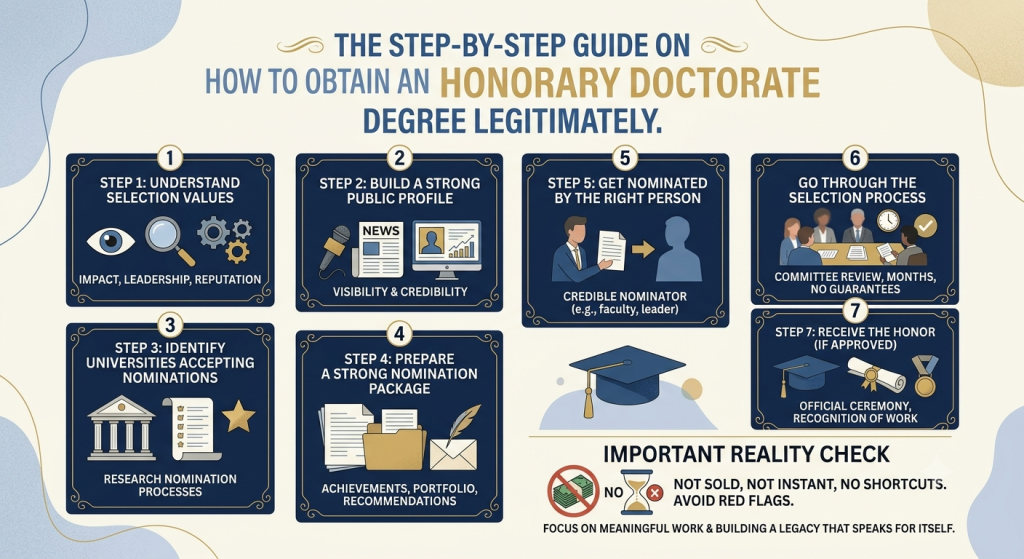
Step 1: Understand What Universities Actually Look For
Before anything else, you need to know what selection committees value.
They don’t look for degrees or certificates.
They look for:
Long-term impact
Real contributions to society
Leadership or innovation
Ethical reputation
Public or industry recognition
This is not about potential—it’s about proven results.
Step 2: Build a Strong Public Profile
Visibility matters.
Even if you’ve done great work, it needs to be visible and credible.
This includes:
Media features or interviews
Industry recognition
Speaking engagements
Online presence and authority
Universities are more likely to consider individuals whose work is already acknowledged publicly.
Step 3: Identify Universities That Accept Nominations
Some universities allow public or external nominations for honorary degrees.
Your goal is to find institutions that:
Have a formal nomination process
Recognize contributions in your field
Maintain credibility and accreditation
Not every university opens nominations publicly, so research is key.
Step 4: Prepare a Strong Nomination Package
This is where most people underestimate the process.
A nomination package should clearly present:
Your achievements
Your impact
Your contributions to society or your field
It may include:
A detailed profile or portfolio
Supporting documents or proof of work
Letters of recommendation
A compelling summary of your journey
The goal is simple—make your impact undeniable.
Step 5: Get Nominated by the Right Person
In many cases, you cannot nominate yourself.
You need someone credible to do it for you.
This could be:
A university faculty member
An industry leader
A professional with authority in your field
The stronger the nominator, the more weight your case carries.
Step 6: Go Through the Selection Process
Once nominated, your profile goes through review.
Committees evaluate:
Credibility
Consistency of impact
Alignment with the university’s values
This process can take months.
There are no guarantees.
Only a small number of nominees are selected each year.
Step 7: Receive the Honor (If Approved)
If selected, you’ll be invited to receive the honorary doctorate during an official ceremony.
This is usually part of a graduation event.
It’s a formal recognition of your work—not just a title.
Important Reality Check
You cannot shortcut this process.
Legitimate honorary doctorates:
Are not sold
Are not instant
Are not guaranteed
If a website promises quick approval or asks for payment in exchange for a degree, it’s a red flag.
Can You Increase Your Chances?
Yes—but indirectly.
You can:
Focus on meaningful work
Create measurable impact
Build credibility over time
Network with the right people
But you cannot force or fast-track it.
Final Thoughts
Obtaining an honorary doctorate isn’t about filling out an application.
It’s about becoming someone worthy of recognition.
The process happens behind the scenes—but your work is what brings you into that conversation.
So instead of chasing the degree, focus on building a legacy that speaks for itself.
Because in the end, that’s what honorary doctorates are really about.
Doctorate Honoris Causa, Honorary Degree, Honorary Doctor, Honorary Doctorate, Honorary Doctorate Degree, Honorary PhD, How to Get an Honorary Doctorate, How to Obtain an Honorary Doctorate