Updated: August 2026 22 min read honorary-doctor.com 2026 Ivy League data Harvard & Yale selection process
Table of Contents
ToggleHonorary degrees at graduation ceremonies are one of American higher education’s oldest traditions. Rather than requiring coursework or a dissertation, an institution simply confers the degree in recognition of someone it judges to have made an extraordinary contribution — to scholarship, philanthropy, public service, human rights, the arts, or society more broadly. Harvard has awarded them since 1692 and Yale since 1702, so this is a tradition stretching well over three centuries at both schools. This guide looks at how these two Ivy League honorary degrees institutions actually choose who receives one, along with 2026 data across the wider how Ivy League universities select honorary degree nominees.
Table of Contents
- The Purpose and Significance of Honorary Degrees
- How Harvard Selects Nominees
- How Yale Selects Nominees
- The Nomination and Review Process
- Cornell’s Exception
- Ivy League Honorary Degrees – 2026
- Other Ivy League Institutions
- Controversies and Challenges
- Frequently Asked Questions
- Final Thoughts
The Purpose and Significance of Honorary Degrees
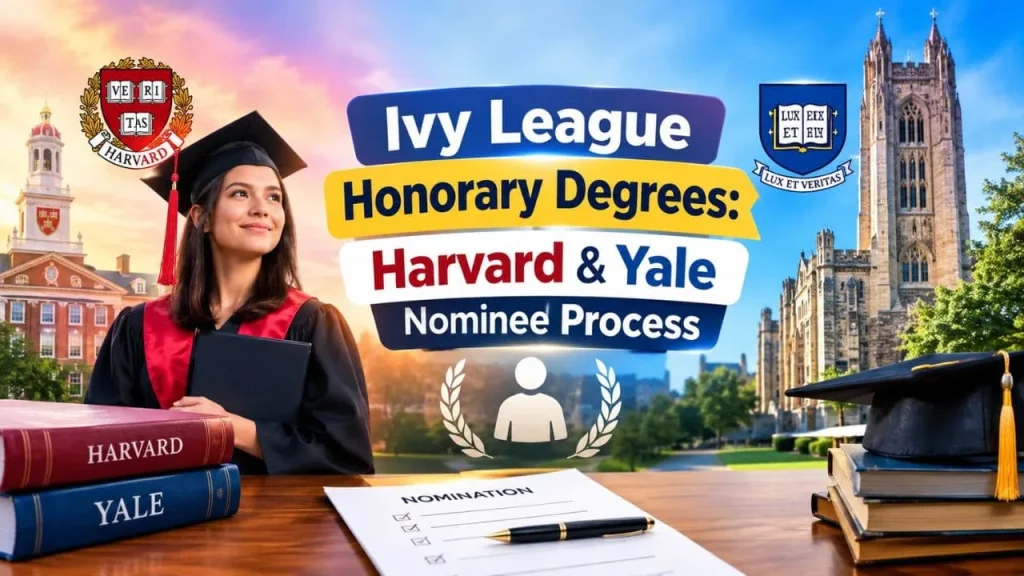
An honorary degree — almost always styled as a doctorate — is sometimes described with the Latin honoris causa (“for the sake of the honor”) or ad honorem (“to the honor”). Because a university is, in effect, publicly aligning itself with whoever it chooses, the Yale honorary degree selection process is never purely ceremonial: it reflects the institution’s own priorities and values, and it can occasionally invite pushback when a choice is contested.
The practice is old. The earliest recorded honorary degree is generally traced to Lionel Woodville, awarded by Oxford in the 15th century. Harvard and Yale both began the practice not long after their founding, in the late 1600s and early 1700s respectively. At most American universities, the process by which nominees are chosen is deliberately opaque, with the winning names typically kept under wraps until they’re announced — often alongside an invitation to deliver the commencement address. Understanding how Yale selects honorary degree recipients offers useful context for how institutions evaluate individuals whose achievements and public contributions align with their academic values.
Yale’s own description of the honor captures the underlying logic well: honorary degree recipients are meant to serve as models for graduating students — people whose lives exemplify the kind of excellence, curiosity, and public-mindedness the university hopes its own graduates will pursue.
Note: Selection committees at both schools work under strict confidentiality, and recipients are typically informed well before the public announcement but asked to keep it quiet — part of why Commencement-day reveals tend to generate genuine campus buzz rather than a formality everyone already expected.
In recent years, both schools’ honoree lists have leaned further into figures working on social justice, environmental science, and global public health — a shift that reflects, at least in part, how these institutions currently think about their broader civic role.
How Harvard Selects Nominees
The Harvard Corporation's Role
Harvard has described its own criterion plainly: honorary degrees go to candidates based on their overall, lifetime body of contributions and accomplishments. A standing subcommittee of the Harvard Corporation — the university’s senior governing board — reviews candidates and narrows the field before bringing a shortlist to the full Corporation, where approval is typically unanimous.
From there, the list goes to the Board of Overseers, Harvard’s second governing board, for final confirmation. Harvard typically selects around ten honorees a year, and recipients are expected to attend Commencement in person to receive the Harvard honorary degrees.
Harvard's Selection Criteria
- Overall and lifetime contributions and accomplishments – the primary criterion
- Alignment with the University’s mission and values
- Diversity of fields represented – arts, sciences, public service, humanities
- Avoidance of controversy – the selection committee carefully vets candidates
- Global impact – contributions with international significance
- Innovation and originality – breakthroughs in their respective fields
As with Yale, the names are held back until Commencement. In spring 2026, Harvard honored five recipients — on the smaller end of its usual range.
The Role of the Board of Overseers
The Board of Overseers — one of Harvard’s two governing boards, made up of alumni elected annually — provides a check on the Corporation’s nominations rather than originating them. The Corporation proposes candidates; the Overseers must concur before a degree is finalized. This two-board structure is characteristic of how Harvard splits governance more broadly, not something unique to honorary degrees.
Because Overseers are elected directly by Harvard’s alumni body, they bring a different vantage point than the Corporation, which has historically been criticized as more insular and self-selecting in how its own members are chosen.
Historical Context
Yale doesn’t publish a fixed checklist of criteria for Yale honorary degrees. Instead, the university describes recipients collectively as people who “represent… the aspirations of this institution” — individuals recognized for genuinely distinctive, field-defining contributions, chosen in part because their example might inspire the graduating class.
How Yale Selects Nominees
No Formal Criteria, But High Standards
Yale doesn’t publish a fixed checklist of criteria. Instead, the university describes recipients collectively as people who “represent… the aspirations of this institution” — individuals recognized for genuinely distinctive, field-defining contributions, chosen in part because their example might inspire the graduating class. Understanding how Yale selects honorary degree nominees therefore depends more on examining the recipients’ achievements, influence, and alignment with the university’s values than on following a formal public checklist.
The Committee Structure
Yale’s Committee on Honorary Degrees draws its members from several parts of the university: the Yale Corporation (the governing board, which has final say via formal vote), the Association of Yale Alumni, the University Council, and the faculty. The committee meets annually to work through the pool of candidates.
- Corporation representatives – Yale’s governing board, which formally votes on the final selections
- AYA representatives – bringing alumni perspective into the process
- University Council representatives – an advisory body drawn from across the Yale community
- Faculty representatives – spanning multiple schools and disciplines
That mix is meant to keep the process from reflecting any single constituency’s preferences too heavily.
The Yale Connection
Yale typically awards eight or nine honorary degrees a year, and it’s common for one to three of them to have an existing Yale degree already. But a prior connection to Yale isn’t a prerequisite — many honorees have none.
The committee has, at times, chosen to recognize people with real but lower-profile public impact, rather than sticking exclusively to already-famous names.
The Role of the Secretary's Office
Each year, the process starts with Yale’s Office of the Secretary reaching out to faculty and other constituencies — including AYA board members and Corporation fellows — to solicit nominations. Nominations aren’t restricted to a formal channel; unsolicited suggestions from alumni are common too.
2026 Update: At Yale’s 325th Commencement in May 2026, the university awarded honorary degrees to eight people: philosopher and writer Kwame Anthony Appiah, statistician/neuroscientist Emery N. Brown, playwright Lynn Nottage, political scientist Robert D. Putnam, former Baltimore mayor Kurt Schmoke, Olympic swimmer Katie Ledecky, chemist JoAnne Stubbe, and religious scholar Ingrid Mattson.
Historical Examples
Yale’s list of past honorees includes well-known instances of the committee getting ahead of a story — recognizing Wangari Maathai and Muhammad Yunus with honorary degrees before either had won a Nobel Peace Prize, for example, which is often cited as evidence the process can identify significant contributions before they become widely famous.
The Nomination and Review Process
From Hundreds to a Handful
Yale’s committee reportedly works from a candidate pool numbering in the low hundreds at any given time, which gets narrowed considerably — down to a much smaller shortlist that receives closer scrutiny, including input from faculty and outside experts familiar with a candidate’s field.
The underlying standard stays consistent throughout that narrowing process: the committee is looking for genuinely distinctive, field-shaping contributions rather than general accomplishment.
The Role of Visibility and Recognition
Not every strong candidate starts out well known. The committee has, on occasion, recognized people working in public health, environmental protection, or poverty reduction in the developing world well before they had any broad name recognition in the U.S. — with a few later going on to win Nobel Prizes. Even so, most nominations that reach the committee involve people who already have some public profile, if only because visibility tends to correlate with a documented, verifiable record of achievement.
Timing Matters
Committees at both schools have shown awareness that timing shapes how an honor is perceived — recognizing people while their contributions are still fresh and relevant, rather than long after the fact, is generally treated as good practice.
Personal Touches
The process isn’t purely clinical. Committee members have occasionally used a selection to mark a personal or symbolic moment — for instance, honoring a public figure whose work resonated with a particular committee member or constituency in a given year.
Harvard's Process
Harvard’s version of this process runs in parallel: a Corporation subcommittee reviews candidates and brings recommendations forward, with the full Corporation and then the Board of Overseers required to sign off. Harvard also accepts nominations from the wider university community, though the process is somewhat less structured than Yale’s formal annual solicitation.
Cornell's Exception
Cornell stands apart from the rest of the Ivy League honorary degrees: it doesn’t award honorary degrees at all, as a matter of institutional policy. In its entire history, it has made exactly two exceptions, both in 1886 — to founding president Andrew Dickson White and to David Starr Jordan, who went on to become the first president of Stanford (after having earned a master’s degree at Cornell). Both were doctorates of law, awarded shortly after Cornell’s second president, Charles Kendall Adams, took office and briefly reversed White’s own no-honorary-degrees policy.
The policy has been revisited by Cornell’s faculty from time to time — including proposals in recent decades to introduce honorary degrees — but it has held. Cornell’s president, rather than an outside honoree, traditionally delivers the commencement address.
Cornell does recognize outstanding achievement through other channels, including various university-specific awards, but it maintains the distinction that an actual Cornell degree is earned, not conferred as an honor.
Ivy League Honorary Degrees – 2026
Across the Ivy League’s eight universities, spring 2026 commencements produced 43 honorary degrees in total. Here’s the breakdown by school:
2026 Ivy League Honorary Degree Recipients
- Brown University: 6 honorary doctorates at its 258th Commencement
- Columbia University: 6 honorary degree recipients
- Cornell University: 0 (does not award honorary degrees)
- Harvard University: 5 honorary degree recipients
- Princeton University: 6 honorary degrees
- University of Pennsylvania: 5 honorary degrees
- Yale University: 8 honorary degree recipients
Total: 43 honorary degrees across 7 institutions
(Dartmouth’s spring 2026 numbers are not broken out separately here; readers looking for a full eight-school count should check that university’s own commencement announcements directly.)
Trends in 2026
A few patterns stood out across this year’s honoree lists:
- Broader representation: a wider range of backgrounds among honorees than in some past years, including more women and people of color.
- International reach: several honorees were recognized for work with clear global stakes — climate, public health, human rights.
- Cross-disciplinary work: a number of honorees were cited for contributions that didn’t fit neatly into a single field.
None of this represents a formal policy shift so much as a continuation of trends that have been building across Ivy League honoree lists for several years.
Other Ivy League Institutions
Brown University
Brown awarded six honorary degrees in 2026. Its process runs through a joint committee of faculty and trustees, who bring recommendations to the full Board of Trustees for approval.
Columbia University
Columbia also awarded six honorary degrees in 2026, through a nominating committee that reports to its Board of Trustees. Columbia’s honorees that year spanned literature, science, and public policy.
Princeton University
Princeton awarded six honorary degrees in 2026, following review by a joint faculty-trustee committee with final sign-off from the Board of Trustees. Its 2026 honorees included figures from artificial intelligence, environmental science, and the humanities.
University of Pennsylvania
Penn awarded five honorary degrees in 2026, chosen through a committee that includes faculty, alumni, and trustees, with the Board of Trustees giving final approval. Its 2026 honorees worked in medicine, business, and social justice.
Controversies and Challenges
Honorary degree selections don’t always go smoothly. Because the choice inevitably reflects on the institution itself, Ivy League schools have periodically faced pushback — from students, faculty, or alumni — when a chosen honoree’s record or public statements were seen as inconsistent with the university’s values.
The General Pattern
These disputes tend to follow a similar arc: a selection draws criticism (sometimes before the ceremony, sometimes only after), the university reviews the concerns, and — in the cases that have become public — the institution has typically stood by its original decision rather than rescinding a degree already announced or conferred. Rescission does happen occasionally across American higher education generally, but it remains rare and is treated as a serious, unusual step rather than a routine response to controversy.
Institutional Responses
Partly in response to past controversies, several Ivy League institutions have tightened their vetting procedures over time — more thorough background review, more input from subject-matter experts, and in some cases clearer public explanation of why a particular honoree was chosen. Some universities have also formalized what a review or rescission process would look like, even if it’s rarely invoked.
- Enhanced vetting: more thorough background checks and expert consultation before a name is finalized
- Public communication: clearer public rationale for why a given honoree was selected
- Formal review procedures: defined (if rarely used) processes for reconsidering a degree if serious new information emerges
The Underlying Tension
At bottom, this reflects a real tension universities can’t fully engineer away: recognizing genuine excellence sometimes means honoring someone whose broader public record isn’t uncontroversial, and a school’s selection committee has to weigh that trade-off knowing the choice will be read, fairly or not, as an institutional endorsement.
Frequently Asked Questions
Who decides who gets an honorary degree at Harvard?
A standing subcommittee of the Harvard Corporation reviews nominees and recommends a shortlist to the full Corporation, which typically votes unanimously to approve it. The Board of Overseers then gives final confirmation.
Who decides who gets an honorary degree at Yale?
Yale’s Committee on Honorary Degrees, made up of Corporation members, faculty, an AYA representative, and a University Council representative, reviews nominations each year. The Office of the Secretary solicits nominations, and any member of the Yale community can submit one.
How many honorary degrees does Yale award each year?
Typically eight or nine.
How many honorary degrees does Harvard award each year?
Around ten in a typical year, though the number varies — Harvard honored five in spring 2026.
Does Cornell award honorary degrees?
No. Cornell is the only Ivy League school that doesn’t, with just two historical exceptions, both from 1886.
How many honorary degrees did the Ivy League award in 2026?
43 across the seven schools that award them (Cornell doesn’t), based on spring 2026 commencement data.
Can anyone nominate someone for an honorary degree at Yale?
Yes — any member of the Yale community can submit a nomination, in addition to the formal solicitation the Secretary’s Office runs each year.
What criteria does Harvard use for selecting honorees?
Harvard’s stated standard is a candidate’s overall, lifetime body of contributions and accomplishments, weighed alongside fit with the university’s mission and the makeup of the broader honoree cohort.
What is the role of the Board of Overseers at Harvard?
It provides final confirmation of the Corporation’s nominees — a check on the process rather than the body that originates candidates.
Are honorary degrees at Yale and Harvard kept secret?
Yes — at both schools, names are generally kept confidential until they’re formally announced around Commencement.
Final Thoughts (2026)
Harvard and Yale run genuinely different processes that land in a similar place. Harvard’s is a two-board system — a Corporation subcommittee proposes, the full Corporation approves, the Overseers confirm. Yale’s leans on a broader standing committee working from a large candidate pool each year, guided by the idea that its honorees should “represent… the aspirations of this institution.”
2026 saw 43 honorary degrees awarded across seven Ivy League schools, continuing a tradition that in Harvard’s and Yale’s cases stretches back more than three centuries. These aren’t simply ceremonial gestures — they’re a fairly direct public statement of what each institution currently values, which is exactly why the selections get scrutinized the way they do.
Cornell remains the clear outlier, having made exactly two exceptions to its no-honorary-degrees policy, both in 1886 — a reminder that “Ivy League tradition” doesn’t mean every school does this the same way.
The broader direction across the schools that do award these degrees seems to be toward somewhat more diverse and more globally-minded honoree lists, without any sign that the underlying secrecy or rigor of the selection process itself is loosening.
— The honorary-doctor.com team, 2026
Academic Credentials, Board of Overseers, Commencement Traditions, Cornell University, Harvard Corporation, Harvard University, Higher Education, Honorary Degree Selection Process, Honorary Degrees, Honorary Doctorate, Honoris Causa, Ivy League, University Governance, Yale University